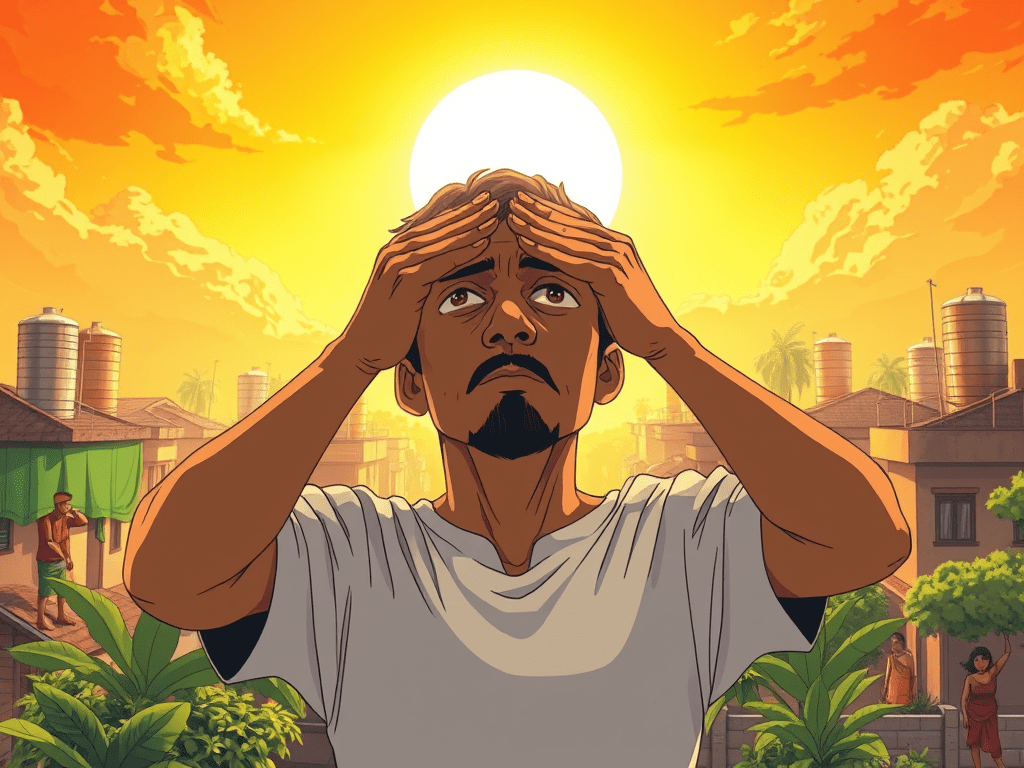
Right now, I’m writing this sitting in Malkapur – my hometown.
Tucked near the border of Madhya Pradesh, right in the heart of Maharashtra, this small town has always held a simple, quiet charm for me. But this time, something feels different.
Summer has arrived, and with it, the brutal reality of rising temperatures. As I walk through familiar streets, I can’t help but notice how people are adapting to survive the heat. Almost every house now has an air conditioner or, at the very least, a water cooler. Honestly, I can’t imagine a home here without one.
Green cloths and makeshift covers hang across balconies, terraces, and windows – a desperate but clever attempt to block the ruthless sunlight from turning homes into furnaces. It’s not just about comfort anymore.
It’s about survival.
Water scarcity is another daily battle. With an unreliable water supply during summer, people have turned to large storage tanks stacked atop their buildings. It’s a common sight now, as essential as the walls that hold the homes together.
As I sit here at 6:20 p.m., during the last week of April, the temperature outside is still hovering around 37°C. It goes up to 43°C at peak time and even at 3:00 a.m night time., when the world should feel a little cooler, it barely drops to 27°C.
That’s the harsh reality today.
And honestly, it’s crazy when I think about how things used to be.
I remember a time – just 10 years back – when we used to play cricket till noon under the summer sun. Sure, it was hot back then too, but it was manageable. We never even thought twice about it.
Today, stepping out after 10 a.m. for a simple game feels unthinkable. The heat isn’t just uncomfortable anymore – it feels dangerous.

This rising temperature wave isn’t just making summers tough.
It’s starting to affect livelihoods.
Daily wage workers, street vendors, construction workers – they now avoid working between 12 to 5 p.m., because it’s almost impossible to function in that kind of heat. Work slows down, incomes shrink, and the struggle only gets harder.
But amidst these challenges, there’s a silver lining.
I noticed something heartening – greenery.
More trees. More plants. It seems people have realized the old wisdom: plant more trees, get more rain. In fact, Malkapur looks much cleaner and greener compared to three or four years ago. It feels like a town trying to breathe again, trying to heal itself in small but significant ways.
Yet, a question lingers in my mind – will these efforts be enough?
Will planting trees, covering windows, and storing water really solve the larger problem of rising temperatures year after year?
Or are we just buying time, without addressing the root causes?
This is a question not just for Malkapur, but for every small town grappling with the harsh face of climate change.
 Vinay Mundhe
Leave a comment