Vinay Mundhe

A Software Developer Writing on Tech, Money, and Life

Author: Vinay Mundhe

  • A Hedge Against the Falling Rupee

    A Hedge Against the Falling Rupee

    Every Indian investor keeps talking about SIPs, large caps, small caps, and midcaps. But hardly anyone talks about something just as important:

    Your wealth is tied to the rupee, and the rupee keeps falling.

    See the following image. This is Rupee depreciation eating into your global purchasing power. You feel rich in INR. You feel average in USD. A big reason for the current FII outflow.

    This is why I’m slowly increasing my U.S. stock allocation.

    Let me break it down simply.

    My current split

    Right now, I have around 18–20% of my portfolio in U.S. equities.
    I’m planning to increase this to 30% over time.

    Not in a hurry.
    Not trying to time anything.
    Just a slow shift.

    Why?

    Because your money is silently losing value when the rupee weakens.

    The math nobody talks about

    This year, the rupee went from ₹83.30 → ₹90.50 against the dollar.

    That’s almost 7 rupees of decline.

    If you had simply held USD, without touching stocks, without doing anything fancy…

    ₹100 worth of dollars would’ve silently turned into ₹108.
    Zero effort.
    Zero stock market risk.
    Pure currency effect.

    Your money grows without the market helping you.

    Now imagine combining this with strong U.S. stocks like
    Apple, Nvidia, Microsoft, Amazon, Broadcom…

    You get a double benefit:

    • USD appreciation
    • U.S. market returns

    Meanwhile, inflation in India + rupee depreciation eats away your returns here.

    This is the part people usually ignore.

    Not running away from India, I’m just being practical

    I still invest heavily in India.
    My high-conviction bets are Indian companies (you already know them).
    But the rupee is not your friend long-term.

    Every decade, it quietly steals from you.

    That’s why I’m adding this hedge.

    How I’m doing it (simple strategy)

    I’m doing three things:

    • Adding slowly to major U.S. tech names
    • Keeping SIPs running in Indian MFs
    • Rebalancing whenever things look off

    30% U.S. exposure is enough to protect the downside and benefit from global growth.

    The takeaway

    Invest in U.S because:

    • Your rupee is weakening
    • Your global purchasing power matters
    • USD appreciation cushions your long-term returns
    • You want a portfolio that works in any scenario

    A simple hedge.
    A smart move.
    And something we Indians should consider seriously.

  • Problem Solvers, Not Coders

    Problem Solvers, Not Coders

    If you’re a software developer in 2025, here’s the harsh truth:
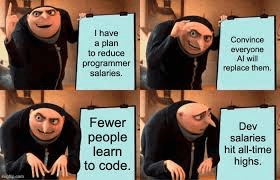
    AI can write cleaner code than you.
    And faster.
    And without taking tea breaks.

    But let me assure you… the companies still need you.

    Not because you can write a controller class or map a JSON properly. But because you can solve problems that AI still can’t understand.

    Let me explain.

    1. Modern backend work is not “write Java code → commit → done.”

    Every system today is a giant maze of services, downstream integrations, rules, edge cases, legacy decisions, and business logic stitched together over many years.

    AI can generate code, sure.
    But can it understand why a downstream service is silently swallowing errors for New York state only?
    Can it debug a 500 that only appears in QA at 3 PM when a specific flag is ON?
    Can it map different responses while also ensuring no other state is impacted?

    No. That’s your job.

    Backend development is not about syntax.
    It’s about context.

    2. The winners in AI era will be “connect-the-dots” engineers

    AI is a beast at tasks.
    But AI still struggles with relationships:

    • Why this field exists
    • How one decision breaks five other flows
    • How legacy systems behave
    • Why a business constraint matters
    • How to design for long-term, not just patchwork

    This is where real engineers win.

    When you can look at a messy system, ask the right questions, and find the real root cause behind an issue… that’s a superpower.

    AI can give answers.
    But it still can’t understand the exact problem.

    3. Every company has complex operations and they need humans with expertise

    You’ve probably seen this in your own job:
    Even simple requests blow up into multi-branch logic, state-specific rules, lookups, transformations, and 10 other conditions.

    AI can’t read 20 years of operational history.
    You can.

    That’s why backend developers who learn to think like problem solvers will grow fast.

    4. How to upgrade yourself starting today

    Here’s what I’m doing in my own journey:

    • I’m learning domain modelling, not just mapping
    • I’m understanding system behaviour, not just services
    • I’m learning to ask: what problem are we solving?
    • I’m building real projects like VinAsset to learn design thinking and practice

    Coding is important.
    But connecting dots is everything.

    The takeaway

    AI won’t replace backend developers who think clearly, understand business deeply, and solve problems at a system level.

    If you want to survive this decade, become the engineer who sees what AI doesn’t:

    The why behind the what.
    The connection behind the code.
    The problem behind the symptom.

  • Reflecting on missed opportunities

    Reflecting on missed opportunities

    10 Years Later, I Finally Get It: Why I Didn’t Grow Like I Could Have.

    By 2014, I was working as a freelance graphic designer as well as doing my engineering.
    It’s been over 10 years now, and when I look back, there’s this weird mix of pride and guilt.

    Pride that I started early.
    Guilt that I didn’t build anything out of it.

    I see fresh college grads today doing freelance work, building global clients, growing audiences online. And I can’t help but think, I was doing this 12 years ago. Back when social media was still young. Back when Jio hadn’t even arrived and changed the game.

    I was there, right in the middle of all of it, working in social media marketing. I had the context. I had the timing. But I didn’t have the system.

    And that’s where I failed.

    Why I think I Couldn’t Capitalise

    • I was serious, but distracted.
      I was always buried in the task at hand, never looking at the bigger picture. Always executing, never planning.
    • I didn’t document anything.
      Had I shared what I was learning, what I was building, what I was struggling with, I could’ve built an audience. An identity. Maybe even a business.
    • I never built on top of what I already had.
      Everything valuable in life compounds. Skills, knowledge, connections, reputation. But only if you stay on one path long enough. I kept starting over.
    • I didn’t leave anything behind.
      No savings. No content. No trail of what I worked on.
      And here’s a harsh truth:

    If you’re doing work that leaves you with nothing at the end of the month…no savings, no assets, no learnings…then you’re just doing donkey work.

    Whatever you save, you build.
    Day by day, something should be stacking…money, knowledge, experience, content. Otherwise, 10 years will pass and you’ll look back to… nothing.

    If you’re reading this, I’ve got one simple message:
    Push yourself just enough.

    Enough to challenge yourself.
    Enough to stack new skills.
    Enough to build something that lasts.

    But not so much that you’re too drained to even enjoy or document the journey.

    So What Now?

    Now I’m choosing to document everything.
    I’ve started showing up consistently on Twitter and LinkedIn.
    And I’m focusing on just three pillars:

    1. My Career – Software Development
    2. My Business – Social Media + Marketing
    3. My Personal Brand – Who I am, what I stand for

    So that when I’m 40, I don’t just have money in the bank…
    I have a body of work to show. A story to tell.
    And a life that actually compounded.

  • I Bought 3 New Stocks

    I Bought 3 New Stocks

    Over the past two months, I added three new stocks to my portfolio.

    All very different businesses. One’s making the tech behind electric vehicles. One’s building the chips powering AI. And one’s trying to rewire the way we discover medicines.

    But the common thread? They’re future-focused. Backed by real fundamentals. And not just “hot” names on social media.

    Here’s a breakdown of each — the story and the numbers.

    1. Sona BLW – India’s EV Backbone

    Sona BLW isn’t loud on Twitter. But it’s quietly becoming a major player in the EV supply chain — they make precision gears, motors, and drivetrains used in EVs and hybrids.

    This isn’t a “future potential” kind of bet. They’re already supplying global automakers, and with the EV shift picking up in India and abroad, the tailwinds are strong.

    Here’s what sealed it for me:

    • Revenue: 3 year CAGR growth – 26.69%
    • Operating Profit Margin: Solid 28.1%
    • Net Profit: ₹518 Cr in FY24, up from ₹395 Cr last year
    • Debt-to-Equity: 0.09 — nearly debt-free
    • EPS: ₹9.57 and improving year-on-year
    • My average buying price: ₹481.38

    In short: stable business, clean balance sheet, future-ready product line. Also, I’m betting on India getting benefitted from the manufacturing shift from China due to heavy US tariff and uncertainty.

    2. AMD – Chips are the New Oil

    I’ve had my eye on semiconductors for a while. When I finally pulled the trigger, I went with AMD.

    Why? Because they’re not just playing catch-up to Nvidia — they’re going after specific markets and winning. Data centers, gaming, high-performance computing, and now AI workloads.

    What gave me conviction:

    • Revenue: $25.8 billion in FY24 — up 14%
    • Net Income: $1.6 billion — 92% jump
    • Data Center Segment: Grew 57% YoY to $3.7 billion in Q1 FY25
    • AI bet: Strong product pipeline + double-digit growth expected in this segment
    • My average buying price: $98.70

    Sure, Nvidia’s the poster child of AI. But it’s already had a run. Where do partner companies will look for when they need an option?

    AMD is the quieter compounding machine. Cheaper valuation, strong fundamentals, and deep R&D bets.

    3. Recursion Pharma – My Moonshot

    Every portfolio needs that one risky, asymmetric bet. For me, that’s Recursion.

    They’re combining biotech with machine learning to speed up drug discovery. It’s risky. It’s bleeding-edge. And it won’t pay off tomorrow. Nvidia has invested in this company and that’s what brought this company to my attention.

    Here’s what I looked at:

    • Revenue: $58.8M in FY24, up from $44.6M
    • Net Loss: $463M — yeah, they’re burning cash
    • Collaborations: Received $30M from Roche & Genentech
    • Backers: Nvidia, Bayer, and others have skin in the game
    • My average buying price: $5.32

    This isn’t a traditional pick. I’m not chasing near-term profits. I’m betting that AI won’t just build apps — it’ll build cures. And Recursion could be part of that shift.

    I bought these US stocks using INDMoney app.

    The transfer of funds to US Wallet was faster and convenient. App UI is simple and has everything you need.

    If you are investing in US market, be prepared to hold long term to get taxed less as long term capital gain tax is lesser than short term capital gains. Also, invest in bigger chunks to reduce the remittance charges.

  • Forget Pakistan. It’s time India levels up.

    Forget Pakistan. It’s time India levels up.

    Another conflict. Another headline cycle. Pakistan threw its usual tantrum. We stayed calm, and this time, we showed them.

    200+ drones. Neutralised overnight.
    Missiles? Shot down.
    Our own version of the Iron Dome? Tested. Live. Not in a lab. Not on a PowerPoint.

    This wasn’t just defense. It was a product demo for the world.

    India’s defence tech isn’t just ready. It’s market-ready. And unlike China’s systems, the ones Pakistan used, ours actually work.

    India’s defense exports has already got the momentum. In 2017 our defense export was around ₹1521 Crore. And now in 2025, exports are up to ₹23600 Crore.

    Its poised to go up and up after this.

    But here’s the thing. This war shouldn’t define us. It should wake us up. Because we already know how to handle Pakistan.

    We bleed them slowly. Quietly.
    “Unknown man kills a terrorist” — that’s the headline we aim for.
    Keep hitting their roots till their morale hits rock bottom.
    So that when the day comes, and we really announce an attack, Pakistani soldiers abandon their border posts and run for their lives.

    That’s how you take down a rogue state — by weakening it from within. Not by reacting, but by outgrowing.

    Pakistan is not the goal. China is.

    I remember reading a line from a Pakistani journalist when our businessmen visited Pakistan for some event few decades back.

    “We don’t fear India’s new weapons. We fear the day Indian billionaires land in Islamabad in their private jets.”

    That’s the power we need to chase. The kind that doesn’t just win battles, but dominates boardrooms.

    We don’t need another border skirmish.
    We need GDP growth.
    We need billion-dollar IPOs.
    We need our own Nvidia, our own Tesla, our own AI giants.

    Let’s not waste time chasing a neighbour stuck in the past.
    Let’s build. Let’s sell. Let’s grow.
    And when the world talks about superpowers in 2040, let’s make sure India isn’t just on the list. It leads it.