Vinay Mundhe

A Software Developer Writing on Tech, Money, and Life

Author: Vinay Mundhe

  • When AI Steps Out of the Screen

    When AI Steps Out of the Screen

    Every day I scroll through news feeds talking about AI breakthroughs-GPTs writing code, Midjourney generating art, AI agents planning our entire day. And yet, when I look around-step outside, walk my street, grab a coffee-everything still feels… normal.

    Still see the traffic, Broken roads, Weird town planning.

    That gap between what AI can do and what we see it doing in the real world? It’s because AI, for now, is trapped. It’s stuck inside screens, chips, and cloud servers. It doesn’t have hands. It doesn’t move.

    But we’re closer to changing that than you think.

    Elon Musk recently shared a video of Tesla’s humanoid robot, Optimus, trying to walk.

    No, it’s not Iron Man (yet). But it’s moving. It’s learning. And what struck me wasn’t just the robot-it was Musk’s quiet announcement: Tesla is preparing to produce 10,000 to 12,000 Optimus units this year. In 2025, that could scale to 5,000 robots ready to hit the real world.

    Let that sink in.

    Not just AI in your pocket. But AI building your world.

    Now imagine this:

    • A team of humanoid robots working on road construction 24/7, without breaks or burnout.
    • A squad assembling homes brick by brick-precision, speed, no human risk.
    • AI-driven city planning bots laying out smarter, greener, more sustainable towns.
    • Manufacturing plants where robots do the heavy lifting, literally, while humans manage, direct, and innovate.

    This isn’t sci-fi anymore. It’s groundwork for the next revolution-when AI doesn’t just think, but also acts.

    And the best part? It could drastically improve the quality of human life. Lower construction costs. Faster disaster relief. Safer, cleaner cities. And maybe, just maybe, help us build homes on Mars one day.

    But here’s the catch-intelligence without ethics is dangerous. We don’t need a real-life Skynet. We need moral frameworks, strict boundaries, and strong governance to guide this tech. These robots shouldn’t just walk-they should walk right.

    We’re entering an era where AI will leave the chat window and walk into our neighborhoods. It’s not a matter of if. It’s when. And it’s happening faster than we think.

    The real question is-are we building the world we want to live in?
  • Zomato Just Replaced 600 Employees With an AI Agent

    Zomato Just Replaced 600 Employees With an AI Agent

    Last night, I opened Zomato to order dinner. Something went wrong with the delivery, classic Friday chaos! I tapped “Support,” expecting a long wait or an endless chatbot loop. Instead, I was done in under two minutes.

    No human, no hold music… just a smooth conversation with what felt like a very, very smart AI. And I thought to myself: Damn, this bot’s got game.

    Then today, I saw the headline:
    Zomato lays off 600 customer support employees.

    Why?
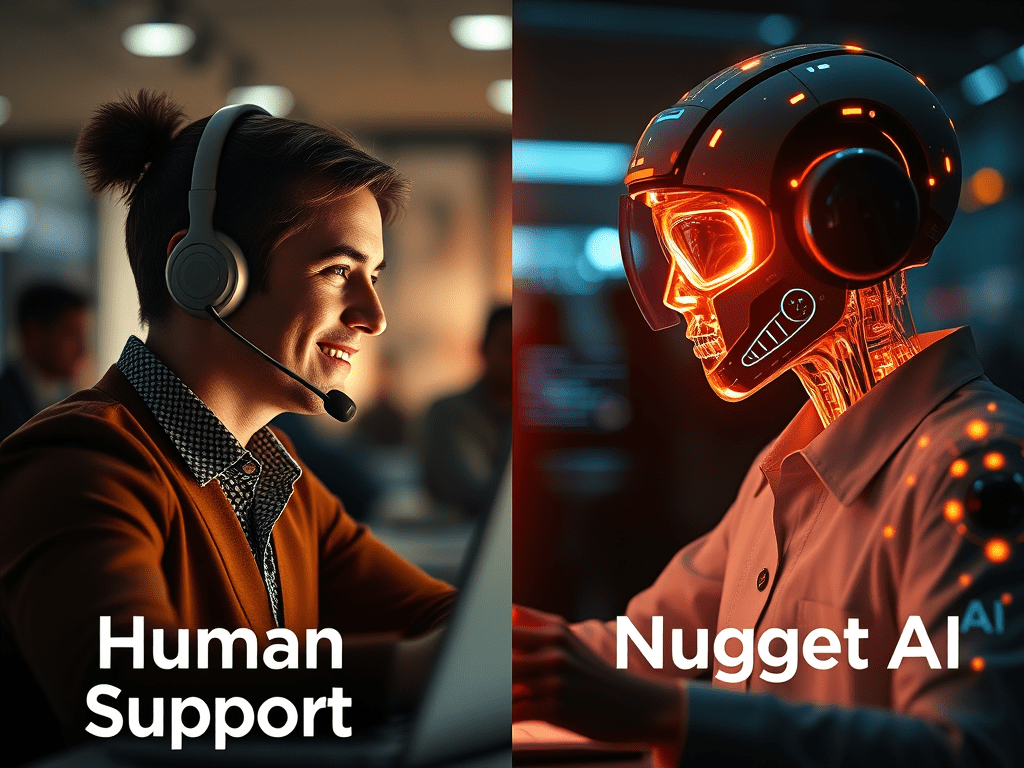
    Because automation is stepping up. And its name is Nugget.

    So… what is Nugget?

    Built over the last 3 years as an internal tool, Nugget isn’t your average “Hi! How can I help you today?” kind of bot. It’s been quietly powering over 15 million support conversations every month across Zomato, Blinkit, and Hyperpure.

    Now it’s out of stealth mode.
    Now it’s public.
    Now it’s replacing jobs.

    Harsh? Maybe. But here’s the kicker…

    Nugget resolves up to 80% of queries autonomously, learns and adapts in real-time, and requires zero code to integrate. No dev team needed. No clunky workflows. Just seamless, customizable automation that actually works.

    90% of companies who’ve tried it signed up.

    Check it out here: nugget.com

    What’s happening behind the scenes?

    Let’s call it what it is… a shift.
    Zomato didn’t just randomly decide to cut 600 jobs. They replaced people with software. Efficient, scalable, tireless software. And they did it because they could.

    I’ve personally seen it in action. As a regular customer, I’ve reached out to Zomato’s support multiple times. From missing items to refunds… Nugget handled it better than most humans would. Fast. Precise. Polite. No attitude. No errors.

    This isn’t just cost-cutting. It’s efficiency at scale.

    And that’s the part no one’s talking about enough.

    But here’s the real question:

    Is this the future of customer support?

    If your business still relies on a bulky support team, long ticketing systems, and manual resolution queues, Nugget is your wake-up call. It’s not just an AI tool. It’s a glimpse of what tomorrow looks like.

    The same way Zomato disrupted food delivery, it’s now disrupting customer support.

    It’s bittersweet.
    600 people lost their jobs. That’s not a small number. But it also signals a massive shift in how tech companies operate. A shift towards leaner ops, AI-first thinking, and internal innovation.

    Nugget isn’t just a support tool.
    It’s Zomato’s first product from Zomato Labs… their innovation incubator.

    The future’s not coming.
    It’s already here.
    And apparently, it’s called Nugget.

  • Budget and the Stock Market

    Budget and the Stock Market

    The budget is out, and it’s clear that government is playing to the masses. More tax benefits, more subsidies, and more money in the hands of the middle class and lower-income groups.

    What does that mean for the stock market?

    Today’s market reaction gave us a preview:

    • PSU stocks (defense, green energy, railway) dipped.
    • Consumption, FMCG, and real estate stocks rallied.

    This isn’t just a one-day trend, it’s a theme that could last months or even years.

    Why Consumption Stocks Will Run

    When people have more disposable income, they spend—it’s basic economics. Think about it:

    • More money saved from tax cuts? → More dining out, ordering food, and shopping. (Zomato, Nestle, ITC, HUL win.)
    • Extra cash flow? → More home upgrades—new ACs, refrigerators, TVs. (Voltas, Havells, Whirlpool benefit.)
    • A stable economy? → More real estate demand. (DLF, Godrej Properties, Macrotech boom.)

    The market is already reacting as Zomato surged 7% today, and FMCG stocks were up 3-4%.

    Now, How to Play This Market?

    The playbook is simple:
    Stay bullish on FMCG, consumption, and real estate.
    Look for companies that benefit from rising consumer spending.
    Avoid PSU-heavy themes unless there’s a policy push.

    Modi government will most likely priorities keeping the masses happy in his third term.

    Play accordingly.

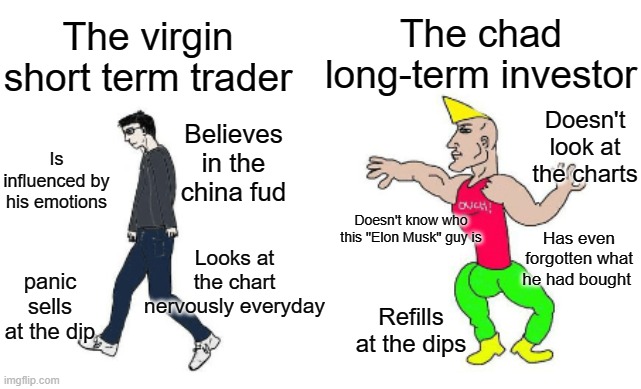
    And if you are a long term investor with a 5-10 years view-point, and you are a chad long term investor, you better keep investing in the companies with good fundamentals, irrespective of the sector.

    As, in the end, India will do well anyhow in the long run.

    We are survivors.

  • How I Pick Stocks Without Overcomplicating It

    How I Pick Stocks Without Overcomplicating It

    Have you heard about the KISS theory?

    KISS stands for “Keep It Simple, Stupid.”

    And honestly, that’s exactly how I approach investing in stocks. No drama, no overthinking, just straightforward logic.

    Speaking of overthinking, have you seen this meme?

    It perfectly sums up the chaos that happens when you complicate what should be simple!

    And believe it or not, ‘The chad long term investor’ is the one who makes a lot of money in stock market.

    So here’s how I keep it simple while choosing a stock:

    1. Data-Driven Decisions: I always base my investment choices on solid data. One of my go-to resources is Screener.in, which offers a lots of data for the Indian stock market. This platform provides various metrics that guide my decisions.

    2. Invest in Transformative Companies: I once heard Jeff Bezos’ philosophy, he said, “Invest in the companies that you think will change the world.”

    This mindset helps identify long-term winners.

    3. Choose Promising Sectors: It’s crucial to invest in sectors poised for significant growth in the next 5-10 years. This forward-thinking approach ensures your investments align with future trends.

    For now I think Renewable energy, EV, Semiconductor, AI, Data centers, Space – are some of the new-age sectors that can be huge in coming years.

    Do your own research on this, but don’t overcomplicate.

    Key Metrics I Focus On:

    • Sales Growth and Net Profit: I examine quarterly results, focusing on sales growth and net profit. I look for companies that have doubled their sales in the last 3 to 4 years, indicating strong growth potential. Net profit is equally important – it shows if a company is not just growing but also profitable.
    • Balance Sheet: I always check reserves and borrowings. Increasing reserves signal a company is setting aside funds for the future, while low long-term debt indicates financial stability.
    • P/E Ratio: This is my starting point. If a stock’s P/E ratio is over 100, it’s often a red flag, unless it’s a new-age company like Zomato, where higher P/Es are more common. Comparing the stock’s P/E with the industry average can provide more context.
    • PEG Ratio: This ratio is crucial. A PEG ratio below 1 often means the stock is undervalued, making it a potentially great buy. But often, I have bought companies having a less than 3 PEG ratio, as the future seemed promising.
    • EPS (Earnings Per Share). It’s a quick way to see how much profit a company is making per share and whether it’s worth my attention. It’s like checking the foundation before building anything fancy—essential and often overlooked.
    • Compounded Growth: I also pay attention to compounded sales and profit growth, along with the stock’s CAGR. Consistent growth over 5 or 10 years is a good indicator of a company’s performance.

    And most importantly, Don’t buy at an all time high.

    Stock market opens everyday (well, almost!). You always get a chance to buy your favorite stock at a better price.

    Investing is all about making informed choices. By focusing on these metrics and selecting sectors with promising futures, you can identify growth-oriented companies with strong potential.

    Be a chad long term investor!

  • Why Zomato Will Be a Multibagger

    Why Zomato Will Be a Multibagger

    I’ve been adding Zomato stock to my portfolio ever since it reported its first-ever quarterly profit in 2023. I continue buying more shares at every dip in its upward trend, bringing my average buying price to around ₹206.

    If you follow CEO Deepinder Goyal or other team members on X, their rapid-fire execution and visionary acquisitions should convince you they’re on track to become a true market giant.

    Here’s a quick look at why this food delivery powerhouse has impressed me so much and why I believe it’s poised to be a multibagger stock:

    Fast, Continuous Execution
    Zomato Gold, the Blinkit ambulance, food-order scheduling, and ongoing app improvements show how CEO Deepinder Goyal and his team move at lightning speed.

    Swiggy and other competitors seem to lack this kind of out-of-the-box thinking and rapid rollout, which means they’ll likely stay in catch-up mode.

    Buying Businesses & Scaling Them (District, Blinkit from Grofers)

    1. Blinkit Acquisition: Zomato acquired Blinkit for $600 million in 2022, and it’s now worth more than $13 billion—one of the most successful acquisitions ever. Blinkit could soon be Zomato’s primary revenue magnet. Its recent numbers are insane:
      • Average order value jumped from INR 582 to INR 625 within a year.
      • Each store earns 10 lakhs a day (up from 6 lakhs a year ago).
      • The top 50 stores earn a staggering 18 lakhs a day.
      • Quick Commerce (QC) is already 40% of their food delivery business.
    2. District: After buying Paytm’s ticketing biz for 2,100 Cr just under a month ago, Zomato sold 700 Cr worth of Coldplay tickets in 60 minutes and 20,000 Diljit Dosanjh tickets in 30 seconds. Now, it’s listing IND vs ENG cricket match tickets. Deepinder Goyal views District as a huge opportunity because he believes the “going-out” and experience economy is next in line for massive growth. Zomato already have Zomaland, a festival that combines food, music, and entertainment.

    Hyperpure (B2B Business)
    Over 30% of Zomato’s revenue comes from Hyperpure, which delivers raw grocery items to restaurants.

    Commitment to Profitability
    Zomato isn’t fooling around with investors’ money. They’re taking real responsibility to make the business profitable, and it’s paying off. This dedication from the CEO and core team is evident.

    Market Valuation & Future Growth

    • Zomato (Public): USD $20–25 billion market cap.
    • Flipkart (Private): ~USD $37.6 billion (July 2021, backed by Walmart).

    Blinkit alone could match Flipkart’s valuation, translating to a 1.5x–2x jump from Zomato’s current value. And that’s without factoring in the food business, District, or Hyperpure.

    Given Deepinder and team’s startup mindset, they’ll keep venturing into any lucrative opportunity they see.

    Are you investing in Zomato, or do you see more promise elsewhere? Let me know in the comments!