
Vinay Mundhe

A Software Developer Writing on Tech, Money, and Life

Tag: indian economy

  • Forget Pakistan. It’s time India levels up.

    Forget Pakistan. It’s time India levels up.

    Another conflict. Another headline cycle. Pakistan threw its usual tantrum. We stayed calm, and this time, we showed them.

    200+ drones. Neutralised overnight.
    Missiles? Shot down.
    Our own version of the Iron Dome? Tested. Live. Not in a lab. Not on a PowerPoint.

    This wasn’t just defense. It was a product demo for the world.

    India’s defence tech isn’t just ready. It’s market-ready. And unlike China’s systems, the ones Pakistan used, ours actually work.
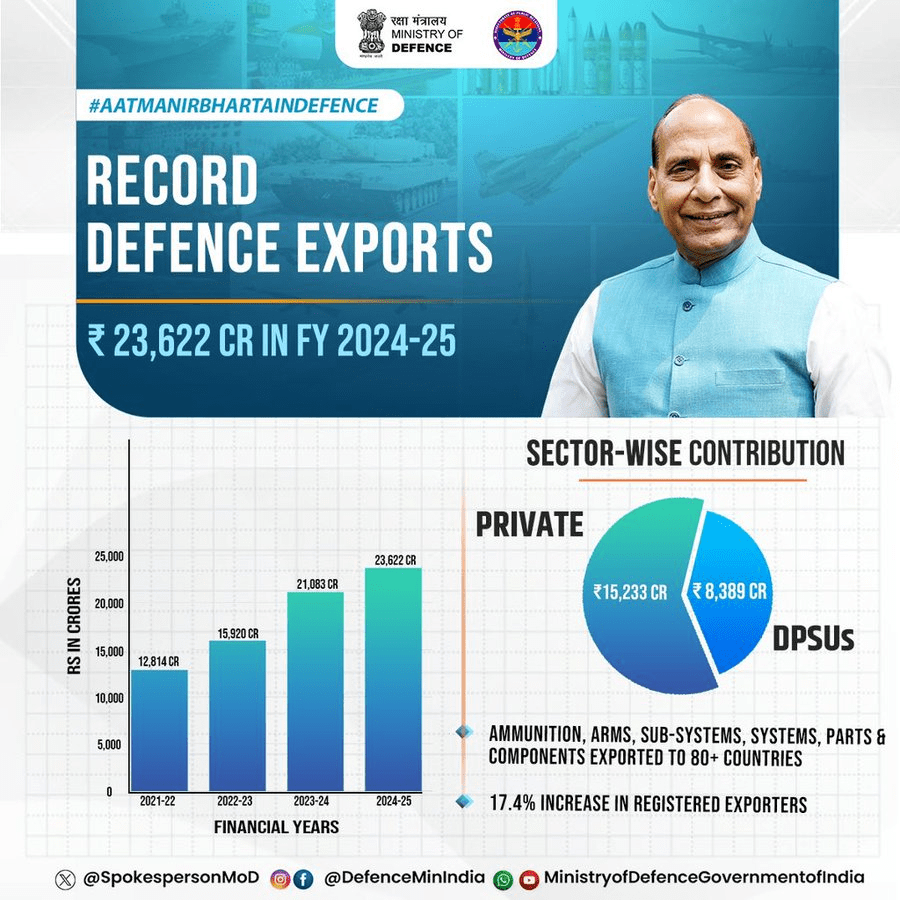
    India’s defense exports has already got the momentum. In 2017 our defense export was around ₹1521 Crore. And now in 2025, exports are up to ₹23600 Crore.

    Its poised to go up and up after this.

    But here’s the thing. This war shouldn’t define us. It should wake us up. Because we already know how to handle Pakistan.

    We bleed them slowly. Quietly.
    “Unknown man kills a terrorist” — that’s the headline we aim for.
    Keep hitting their roots till their morale hits rock bottom.
    So that when the day comes, and we really announce an attack, Pakistani soldiers abandon their border posts and run for their lives.

    That’s how you take down a rogue state — by weakening it from within. Not by reacting, but by outgrowing.

    Pakistan is not the goal. China is.

    I remember reading a line from a Pakistani journalist when our businessmen visited Pakistan for some event few decades back.

    “We don’t fear India’s new weapons. We fear the day Indian billionaires land in Islamabad in their private jets.”

    That’s the power we need to chase. The kind that doesn’t just win battles, but dominates boardrooms.

    We don’t need another border skirmish.
    We need GDP growth.
    We need billion-dollar IPOs.
    We need our own Nvidia, our own Tesla, our own AI giants.

    Let’s not waste time chasing a neighbour stuck in the past.
    Let’s build. Let’s sell. Let’s grow.
    And when the world talks about superpowers in 2040, let’s make sure India isn’t just on the list. It leads it.


  • Indian Banks: The Biggest Legal Robbers No One Talks About

    Indian Banks: The Biggest Legal Robbers No One Talks About

    Let’s start with a simple question — when you open a savings account, who do you think is doing a favor? You, by trusting them with your money? Or them, by “letting” you be their customer?

    If you said “them,” congratulations, you just described the Indian banking system’s mindset.

    How Indian Banks Are Robbing You Silently

    Let’s talk about facts, not feelings.

    According to a report from The Hindu Business Line, public sector banks (PSBs) alone collected around ₹8500 crore between FY20 and FY24 just by penalizing people for not maintaining minimum balance.

    Yes, you read that right.

    In the middle of a pandemic, inflation, job cuts — our “saviours” were busy fining people for not keeping enough money in their accounts. The same people who probably couldn’t make ends meet were slapped with penalties because their account balance wasn’t up to the banks’ “standards.”

    Imagine punishing a drowning man for not swimming properly.

    And it doesn’t end there.

    As per another report by Moneylife, banks have written off ₹1.635 lakh crore of bad loans in just the past ten years.

    You and I are being fined for not keeping ₹5000 in our account. Meanwhile, the big boys — companies and corporates — default on crores, and the banks just “write it off.” It’s like you lending money to someone, they ghost you, and you just shrug and say, “Forget it.”

    But if your balance falls by ₹50, you’re a criminal in their eyes.

    Who Are Banks Actually Working For?

    It’s clear — banks in India seem to work for the big corporates, not the common man.

    They squeeze the small guy dry with penalties, fees, hidden charges, service tax, and then calmly “forgive” massive loans of rich borrowers. No follow-ups. No stress. No shame.

    And you know what’s worse?

    Despite this robbery model, they are still some of the “top” companies in India.

    Compare This: India vs USA

    Let’s look at the latest top 10 companies by market cap.

    US Top 10 (April 2025):

    • Apple
    • Microsoft
    • Nvidia
    • Alphabet (Google)
    • Amazon
    • Meta (Facebook)
    • Berkshire Hathaway
    • Eli Lilly
    • Broadcom
    • Exxon Mobil

    Almost all are tech, innovation, or healthcare-driven, except Berkshire and Exxon.

    India Top 10 (April 2025):

    • Reliance Industries
    • TCS (Tata Consultancy Services)
    • HDFC Bank
    • ICICI Bank
    • Infosys
    • Bharti Airtel
    • State Bank of India (SBI)
    • Kotak Mahindra Bank
    • ITC
    • Bajaj Finance

    Notice something?

    Banks everywhere.

    The US top companies are inventing the future. Our top companies are collecting EMIs, charging penalties, and funding “write-offs.” This is the sad reality.

    What’s the Cost to Us?

    This system discourages savings, hurts financial literacy, and makes the common person feel small and helpless.

    Instead of rewarding savers, supporting small businesses, or investing aggressively into tech, innovation, or manufacturing — our banking system is busy building castles of “service charges” and “processing fees” on the backs of regular citizens.

    Banks were supposed to be pillars of trust. Instead, they have become legalized mafia, operating behind a curtain of regulation.

    Time for a Wake-Up Call

    The next time you hear a politician or a banker talk about “financial inclusion,” remember — the same system is designed to profit off your struggle.

    The same system that fines you for being poor and forgives billionaires for being reckless.

    Maybe it’s time we start questioning not just bad governance but also bad banking.

    Because if banks are supposed to be the backbone of our economy, ours are busy breaking it, one penalty at a time.

    Stay aware. Stay woke. Protect your money — because clearly, no one else will.