Vinay Mundhe

A Software Developer Writing on Tech, Money, and Life

Tag: Stock

  • How I Pick Stocks Without Overcomplicating It

    How I Pick Stocks Without Overcomplicating It

    Have you heard about the KISS theory?

    KISS stands for “Keep It Simple, Stupid.”

    And honestly, that’s exactly how I approach investing in stocks. No drama, no overthinking, just straightforward logic.

    Speaking of overthinking, have you seen this meme?
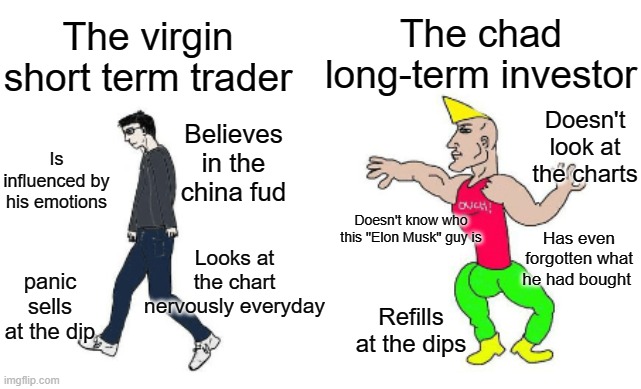
    It perfectly sums up the chaos that happens when you complicate what should be simple!

    And believe it or not, ‘The chad long term investor’ is the one who makes a lot of money in stock market.

    So here’s how I keep it simple while choosing a stock:

    1. Data-Driven Decisions: I always base my investment choices on solid data. One of my go-to resources is Screener.in, which offers a lots of data for the Indian stock market. This platform provides various metrics that guide my decisions.

    2. Invest in Transformative Companies: I once heard Jeff Bezos’ philosophy, he said, “Invest in the companies that you think will change the world.”

    This mindset helps identify long-term winners.

    3. Choose Promising Sectors: It’s crucial to invest in sectors poised for significant growth in the next 5-10 years. This forward-thinking approach ensures your investments align with future trends.

    For now I think Renewable energy, EV, Semiconductor, AI, Data centers, Space – are some of the new-age sectors that can be huge in coming years.

    Do your own research on this, but don’t overcomplicate.

    Key Metrics I Focus On:

    • Sales Growth and Net Profit: I examine quarterly results, focusing on sales growth and net profit. I look for companies that have doubled their sales in the last 3 to 4 years, indicating strong growth potential. Net profit is equally important – it shows if a company is not just growing but also profitable.
    • Balance Sheet: I always check reserves and borrowings. Increasing reserves signal a company is setting aside funds for the future, while low long-term debt indicates financial stability.
    • P/E Ratio: This is my starting point. If a stock’s P/E ratio is over 100, it’s often a red flag, unless it’s a new-age company like Zomato, where higher P/Es are more common. Comparing the stock’s P/E with the industry average can provide more context.
    • PEG Ratio: This ratio is crucial. A PEG ratio below 1 often means the stock is undervalued, making it a potentially great buy. But often, I have bought companies having a less than 3 PEG ratio, as the future seemed promising.
    • EPS (Earnings Per Share). It’s a quick way to see how much profit a company is making per share and whether it’s worth my attention. It’s like checking the foundation before building anything fancy—essential and often overlooked.
    • Compounded Growth: I also pay attention to compounded sales and profit growth, along with the stock’s CAGR. Consistent growth over 5 or 10 years is a good indicator of a company’s performance.

    And most importantly, Don’t buy at an all time high.

    Stock market opens everyday (well, almost!). You always get a chance to buy your favorite stock at a better price.

    Investing is all about making informed choices. By focusing on these metrics and selecting sectors with promising futures, you can identify growth-oriented companies with strong potential.

    Be a chad long term investor!

  • Why Zomato Will Be a Multibagger

    Why Zomato Will Be a Multibagger

    I’ve been adding Zomato stock to my portfolio ever since it reported its first-ever quarterly profit in 2023. I continue buying more shares at every dip in its upward trend, bringing my average buying price to around ₹206.

    If you follow CEO Deepinder Goyal or other team members on X, their rapid-fire execution and visionary acquisitions should convince you they’re on track to become a true market giant.

    Here’s a quick look at why this food delivery powerhouse has impressed me so much and why I believe it’s poised to be a multibagger stock:

    Fast, Continuous Execution
    Zomato Gold, the Blinkit ambulance, food-order scheduling, and ongoing app improvements show how CEO Deepinder Goyal and his team move at lightning speed.

    Swiggy and other competitors seem to lack this kind of out-of-the-box thinking and rapid rollout, which means they’ll likely stay in catch-up mode.

    Buying Businesses & Scaling Them (District, Blinkit from Grofers)

    1. Blinkit Acquisition: Zomato acquired Blinkit for $600 million in 2022, and it’s now worth more than $13 billion—one of the most successful acquisitions ever. Blinkit could soon be Zomato’s primary revenue magnet. Its recent numbers are insane:
      • Average order value jumped from INR 582 to INR 625 within a year.
      • Each store earns 10 lakhs a day (up from 6 lakhs a year ago).
      • The top 50 stores earn a staggering 18 lakhs a day.
      • Quick Commerce (QC) is already 40% of their food delivery business.
    2. District: After buying Paytm’s ticketing biz for 2,100 Cr just under a month ago, Zomato sold 700 Cr worth of Coldplay tickets in 60 minutes and 20,000 Diljit Dosanjh tickets in 30 seconds. Now, it’s listing IND vs ENG cricket match tickets. Deepinder Goyal views District as a huge opportunity because he believes the “going-out” and experience economy is next in line for massive growth. Zomato already have Zomaland, a festival that combines food, music, and entertainment.

    Hyperpure (B2B Business)
    Over 30% of Zomato’s revenue comes from Hyperpure, which delivers raw grocery items to restaurants.

    Commitment to Profitability
    Zomato isn’t fooling around with investors’ money. They’re taking real responsibility to make the business profitable, and it’s paying off. This dedication from the CEO and core team is evident.

    Market Valuation & Future Growth

    • Zomato (Public): USD $20–25 billion market cap.
    • Flipkart (Private): ~USD $37.6 billion (July 2021, backed by Walmart).

    Blinkit alone could match Flipkart’s valuation, translating to a 1.5x–2x jump from Zomato’s current value. And that’s without factoring in the food business, District, or Hyperpure.

    Given Deepinder and team’s startup mindset, they’ll keep venturing into any lucrative opportunity they see.

    Are you investing in Zomato, or do you see more promise elsewhere? Let me know in the comments!